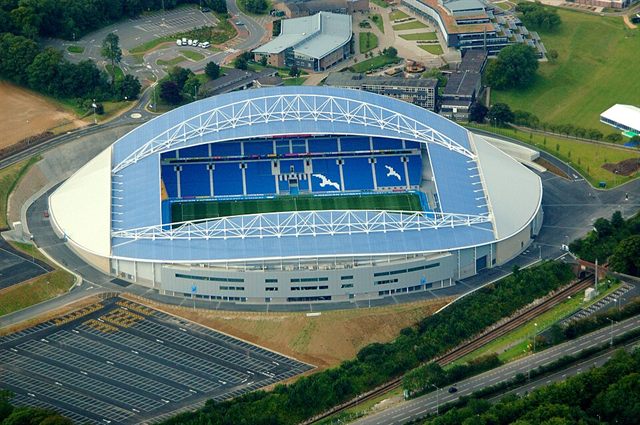
Photo Barbara van Cleve · CC BY-SA 4.0 · Wikimedia Commons
Brighton · EN · England
American Express Stadium
American Express Stadium · The Amex
Built at Falmer, on the eastern edge of Brighton and Hove, the stadium opened in 2011 as the home of Brighton & Hove Albion after more than a decade of planning disputes. It has been known as the American Express Stadium since a naming-rights deal was announced in 2010.
The facts
The Community Stadium Limited · Brighton & Hove Albion
Village Way, BN1 9BL Brighton
The history
The club's previous home, the Goldstone Ground, was sold to developers in 1995 with no new home arranged. Brighton groundshared for two seasons at Gillingham's Priestfield Stadium in Kent, then returned to Brighton as tenants of Withdean Stadium. A site at Falmer was identified in the 1998–99 season.
Planning took more than a decade. Brighton and Hove City Council granted permission in June 2002, but neighbouring Lewes District Council and local residents opposed the plans, partly because the site lies in the South Downs Area of Outstanding Natural Beauty. The Deputy Prime Minister, John Prescott, approved the plans in October 2005, then withdrew the approval in April 2006 after admitting he had been working from a misunderstanding about how much of the site lay in Lewes. Hazel Blears re-affirmed the approval in July 2007, and the permission became final in September 2007.
The Buckingham Group signed the construction contract in November 2008, and work began on the site in December 2008. The stadium was built three storeys down into the ground, and 138,000 cubic metres of chalk excavated during the work was put on a field south of Village Way. The architects were KSS Design Group. The naming-rights deal with American Express was announced in June 2010.
The stadium was handed over to the club on 31 May 2011. The first competitive match there was the Sussex Senior Cup final on 16 July 2011, which Brighton's development squad won 2-0 against Eastbourne Borough. The stadium officially opened on 30 July 2011 with a friendly against Tottenham Hotspur, which the home side lost 3-2. Capacity grew to about 30,750 by the end of the 2012–13 season, and Premier League football arrived in August 2017. Brighton played their first European match there against AEK Athens in the UEFA Europa League on 21 September 2023.
Great moments
 Brighton & Hove Albion2-3
 Tottenham Hotspur
Records
Home to
Brighton & Hove Albion
Home since 2011
Brighton & Hove Albion W.F.C.
Occasional home matches since the 2021–22 season
Getting there
Falmer station is next to the ground, on the East Coastway Line. Southern runs trains to Brighton (about nine minutes), Lewes (about seven minutes) and Eastbourne. There are no direct trains to London, so supporters change at Brighton or Lewes.
Routes 3X, 23, 25 and 28/29 serve the stadium, with football buses on matchdays.
The A27 Brighton by-pass runs close to the site, linking north to the A23 and the M23 towards London and south to the A270 and the city centre.
Tour
Stadium tour
The club's own page should be checked for stadium tour details.
The neighbourhood
The stadium stands at Falmer on the eastern edge of Brighton and Hove, beside the University of Sussex campus. The site lies within the South Downs Area of Outstanding Natural Beauty, though outside the National Park, and its north-eastern corner falls in the Lewes district.
The surrounding area was designed to hold more than football. Its facilities include a banqueting and conference suite, a nursery school, teaching space for the University of Brighton and offices for the University of Sussex. The stadium's bar, named after the club's life president, Dick Knight, sits above the club shop.
About
What bora.fans is, in three paragraphs.
bora.fans is a football matchday concierge. You pick the match; the page gathers everything around it — tickets, flights, coaches, accommodation, the stadium, the bars and restaurants nearby, and the club's official shirt.
Matches, tables, line-ups and live scores come from ge. The guides — club by club, stadium by stadium — were written by people, in Portuguese. Each match's weather forecast is measured, not invented: when there's no reading for that day, the page says so.
bora.fans is not affiliated with any club, league, federation or confederation, nor with ge or Grupo Globo. It's an independent site that organises public information and points to whoever sells.
Updated 3 September 2026
Curation
How places and guides are chosen.
Every address on the page was chosen by hand and tied to a stadium, not a city. Distance is measured from the stadium's own coordinates, which is why one bar shows up in one band for the Maracanã and a different one for São Januário — the two are 2.4 km apart.
Nothing here is generated automatically. The guides are text written by people; squads carry the date that list was true, rather than pretending it holds forever.
When we don't know, the page says so. A stadium with no guide shows no guide; a player with no birth year stays without one. We'd rather leave a field empty than a guess that looks like a fact.
Updated 3 September 2026
Advertise
We haven't published a rate card yet — and the reason is simple.
A media kit states price and reach. We don't have audited audience numbers to publish, and publishing estimates would be exactly the kind of claim this site avoids everywhere else in its content.
When there's something verifiable to state, the rate card goes here. Until then, partnership proposals are welcome at the email below.
Updated 3 September 2026
Contact
For corrections, partnerships and removal requests.
If something on this page is wrong — a kick-off time, a stadium, a score, a player's name — write in. A data correction is the request we like getting most.
This is also where to request a photo's removal, resolve a copyright question, or propose a partnership.
Updated 3 September 2026
Privacy
What's stored, where, and what never leaves your browser.
There's no account, login or sign-up on bora.fans. None of our databases store who you are: there's no user to associate anything with.
Two things live in your own browser. The origin city you choose is stored in localStorage, under the key bora.origin, and your chosen language is stored in a cookie called bf_lang. Both exist so the page doesn't ask again on every visit, and you clear both by clearing the site's data.
If you allow location access, your browser reports a point that we use to suggest the nearest origin city. That point is never sent anywhere: the comparison happens inside the page, against a list of cities that already ships with it. The permission is your browser's, and you can revoke it at any time.
The network that serves the site reports the country and continent the request came from, and we use that only to order matches — the nearest competition first. It isn't recorded.
Purchases happen on each partner's own site. bora.fans never sees a card, a national ID number, or a delivery address, because none of that passes through here.
The infrastructure is enterprise-grade edge infrastructure, ready for LGPD, GDPR and CCPA. To exercise any right under those laws, write to the email below — in practice, what we have to delete fits inside your own browser.
Updated 3 September 2026
Terms
The rules of use, no fine print.
Using bora.fans is free. We earn a commission from affiliate partners when you book through here, and you pay exactly the same as you would going direct.
Information is organised carefully and can still be wrong or out of date. Matches get rescheduled, stadiums change, prices vary. Always check the official channel before buying a ticket, a fare or accommodation — the decision and the risk of the purchase are yours.
Scores, tables, line-ups and rounds are published by ge. We're not responsible for that data and have no relationship with whoever publishes it.
Every purchase is a contract between you and the partner who sold it. Cancellation, refunds, delays and billing are resolved with them, under their own terms.
The text, the guides and the pages' organisation are ours. Crests, photos and marks belong to their owners and appear here for reference, with credit where the licence requires it.
Updated 3 September 2026
Cookies
There's one. It's called bf_lang.
bora.fans uses exactly one cookie: bf_lang, which stores the language you chose. It's only written when you deliberately switch language — browsing the site without touching that control writes nothing.
It lasts a year, because language isn't a session preference: whoever wants Spanish today will want Spanish next month too.
There's no analytics, advertising, social-network or third-party cookie. We don't use a Facebook pixel, Google Analytics or anything similar. That's why there's no cookie banner here: there's nothing for you to consent to.
The origin city lives in localStorage, under the key bora.origin. That isn't a cookie and is never sent to the server in any request — it stays in the browser until you clear the site's data.
The stadium's map is a Google Maps iframe and follows Google's own cookie policy. It's the only third-party content the page loads.
Updated 3 September 2026
Affiliates
We earn a commission. You pay the same.
Several links on this page are affiliate links: if you book a flight, a hotel, a coach fare or a shirt through them, we receive a commission from the partner.
That doesn't change your price. The commission comes out of the partner's margin, not your pocket, and the amount is the same as you'd pay typing their address into your browser.
Partners are chosen by who can actually serve that match. A company that doesn't cover the match's city doesn't appear on the card — even if it's in our records — because naming someone who can't serve you is the whole promise and none of the delivery.
No partner pays for a better position, and commission decides the order of nothing on this page.
Updated 3 September 2026
No sign-up
Demo account
Sign in with no email and no password to see how it works. Picks and alerts disappear when you close the tab.
Want to save it for real? Create account