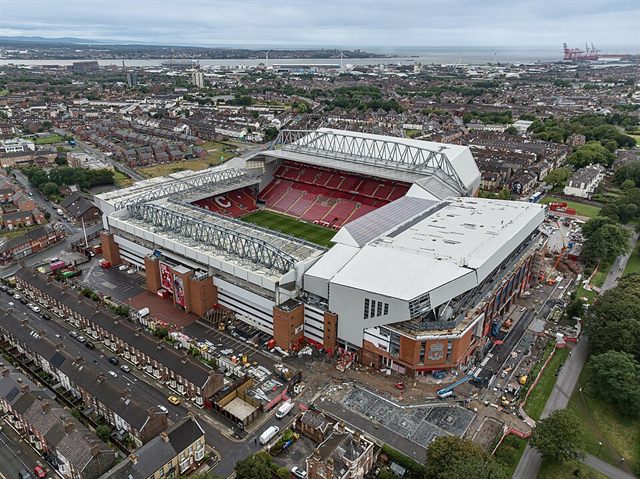
Photo Arne Müseler · CC BY-SA 3.0 de · Wikimedia Commons
Liverpool · EN · England
Anfield
Anfield
Home of Liverpool since 1892, when the club took over the ground Everton had left for Goodison Park. Its Kop, the single-tiered stand behind one goal, is the club's best-known end.
The facts
Liverpool F.C.
Anfield Road, Anfield, Liverpool L4 0TH
The history
Everton played at Anfield from 1884, on a pitch lent by the landowner John Orrell, a friend of Everton member John Houlding. Everton left for Goodison Park in 1892 after a dispute over how the club was run, and Houlding formed Liverpool to occupy the empty ground. Liverpool's first match there was a friendly against Rotherham Town on 1 September 1892, which they won 7-1.
Liverpool's first Football League match at Anfield, against Lincoln City on 9 September 1893, was won 4-0. A stand for 3,000 spectators was built on the site of the present Main Stand in 1895, and the terrace behind one goal was named the Spion Kop after the Boer War battle, in 1906.
The Kop was rebuilt and extended in 1928 to hold 30,000 standing spectators, and it was the largest such terrace in the country at the time. Floodlights were installed in 1957. The Main Stand was partly demolished and rebuilt in 1973, and was opened by the Duke of Kent that year. The Shankly Gates, a tribute to Bill Shankly, were erected in 1982.
A second tier was added to the Kemlyn Road stand in 1992 and renamed the Centenary Stand. After the Hillsborough disaster in 1989 and the Taylor Report, the Kop was rebuilt as an all-seater stand in 1994, with its capacity reduced to 12,390.
The Main Stand was rebuilt and extended in 2016, raising the stadium's capacity to 54,074. The Anfield Road End was redeveloped in phases from 2021 and was completed in 2024, taking the ground above 60,000 seats.
Great moments
 Everton5-0Earlestown
 England6-1
 Ireland
 Liverpool7-1Rotherham TownLiverpool×Wolverhampton Wanderers
Records
Home to
Liverpool
Home since 1892
Formerly home to
Everton
1884–1892
Getting there
Kirkdale is the nearest railway station to the ground.
Fans travelling by train may book the Soccerbus service, which runs from Sandhills station on the Merseyrail Northern Line on matchdays.
Liverpool Lime Street, on a branch of the West Coast Main Line from London Euston, is the main line station for the city.
The stadium has no parking for supporters. The streets around the ground allow parking for residents with permits only.
Tour
LFC Stadium Tour
Anfield, LiverpoolGuided tours of the stadium, including the club museum, are bookable on the club's own website.
Book the tourThe neighbourhood
Anfield is a district of north Liverpool. The name is said to come from Old and Middle English words meaning 'a field on a slope', and the area has been known by it since at least 1642.
In 2014 the club, Liverpool City Council and Your Housing Group signed an agreement to redevelop the surrounding area, a project worth around £260 million. The Shankly Gates and the Paisley Gateway stand outside the Anfield Road End and the Kop.
About
What bora.fans is, in three paragraphs.
bora.fans is a football matchday concierge. You pick the match; the page gathers everything around it — tickets, flights, coaches, accommodation, the stadium, the bars and restaurants nearby, and the club's official shirt.
Matches, tables, line-ups and live scores come from ge. The guides — club by club, stadium by stadium — were written by people, in Portuguese. Each match's weather forecast is measured, not invented: when there's no reading for that day, the page says so.
bora.fans is not affiliated with any club, league, federation or confederation, nor with ge or Grupo Globo. It's an independent site that organises public information and points to whoever sells.
Updated 3 September 2026
Curation
How places and guides are chosen.
Every address on the page was chosen by hand and tied to a stadium, not a city. Distance is measured from the stadium's own coordinates, which is why one bar shows up in one band for the Maracanã and a different one for São Januário — the two are 2.4 km apart.
Nothing here is generated automatically. The guides are text written by people; squads carry the date that list was true, rather than pretending it holds forever.
When we don't know, the page says so. A stadium with no guide shows no guide; a player with no birth year stays without one. We'd rather leave a field empty than a guess that looks like a fact.
Updated 3 September 2026
Advertise
We haven't published a rate card yet — and the reason is simple.
A media kit states price and reach. We don't have audited audience numbers to publish, and publishing estimates would be exactly the kind of claim this site avoids everywhere else in its content.
When there's something verifiable to state, the rate card goes here. Until then, partnership proposals are welcome at the email below.
Updated 3 September 2026
Contact
For corrections, partnerships and removal requests.
If something on this page is wrong — a kick-off time, a stadium, a score, a player's name — write in. A data correction is the request we like getting most.
This is also where to request a photo's removal, resolve a copyright question, or propose a partnership.
Updated 3 September 2026
Privacy
What's stored, where, and what never leaves your browser.
There's no account, login or sign-up on bora.fans. None of our databases store who you are: there's no user to associate anything with.
Two things live in your own browser. The origin city you choose is stored in localStorage, under the key bora.origin, and your chosen language is stored in a cookie called bf_lang. Both exist so the page doesn't ask again on every visit, and you clear both by clearing the site's data.
If you allow location access, your browser reports a point that we use to suggest the nearest origin city. That point is never sent anywhere: the comparison happens inside the page, against a list of cities that already ships with it. The permission is your browser's, and you can revoke it at any time.
The network that serves the site reports the country and continent the request came from, and we use that only to order matches — the nearest competition first. It isn't recorded.
Purchases happen on each partner's own site. bora.fans never sees a card, a national ID number, or a delivery address, because none of that passes through here.
The infrastructure is enterprise-grade edge infrastructure, ready for LGPD, GDPR and CCPA. To exercise any right under those laws, write to the email below — in practice, what we have to delete fits inside your own browser.
Updated 3 September 2026
Terms
The rules of use, no fine print.
Using bora.fans is free. We earn a commission from affiliate partners when you book through here, and you pay exactly the same as you would going direct.
Information is organised carefully and can still be wrong or out of date. Matches get rescheduled, stadiums change, prices vary. Always check the official channel before buying a ticket, a fare or accommodation — the decision and the risk of the purchase are yours.
Scores, tables, line-ups and rounds are published by ge. We're not responsible for that data and have no relationship with whoever publishes it.
Every purchase is a contract between you and the partner who sold it. Cancellation, refunds, delays and billing are resolved with them, under their own terms.
The text, the guides and the pages' organisation are ours. Crests, photos and marks belong to their owners and appear here for reference, with credit where the licence requires it.
Updated 3 September 2026
Cookies
There's one. It's called bf_lang.
bora.fans uses exactly one cookie: bf_lang, which stores the language you chose. It's only written when you deliberately switch language — browsing the site without touching that control writes nothing.
It lasts a year, because language isn't a session preference: whoever wants Spanish today will want Spanish next month too.
There's no analytics, advertising, social-network or third-party cookie. We don't use a Facebook pixel, Google Analytics or anything similar. That's why there's no cookie banner here: there's nothing for you to consent to.
The origin city lives in localStorage, under the key bora.origin. That isn't a cookie and is never sent to the server in any request — it stays in the browser until you clear the site's data.
The stadium's map is a Google Maps iframe and follows Google's own cookie policy. It's the only third-party content the page loads.
Updated 3 September 2026
Affiliates
We earn a commission. You pay the same.
Several links on this page are affiliate links: if you book a flight, a hotel, a coach fare or a shirt through them, we receive a commission from the partner.
That doesn't change your price. The commission comes out of the partner's margin, not your pocket, and the amount is the same as you'd pay typing their address into your browser.
Partners are chosen by who can actually serve that match. A company that doesn't cover the match's city doesn't appear on the card — even if it's in our records — because naming someone who can't serve you is the whole promise and none of the delivery.
No partner pays for a better position, and commission decides the order of nothing on this page.
Updated 3 September 2026
No sign-up
Demo account
Sign in with no email and no password to see how it works. Picks and alerts disappear when you close the tab.
Want to save it for real? Create account