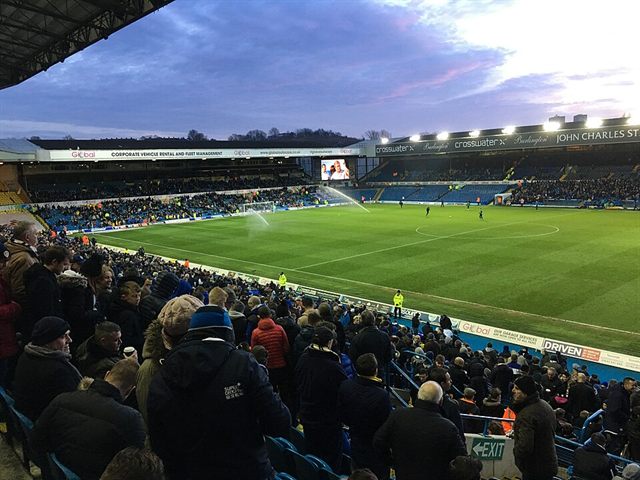
Photo chillilogic.com · CC BY 2.0 · Wikimedia Commons
Leeds · EN · England
Elland Road
Elland Road Stadium
Leeds United's home since 1919, Elland Road has held the club's record crowd of 57,892 and has hosted England internationals and matches at Euro 96. It is also a rugby league and rugby union venue.
The facts
Leeds United Football Club Limited · Leeds United
Elland Road, Beeston, Leeds LS11 0ES
The history
Elland Road was first used in 1897 by Holbeck, a rugby league club, and was taken over by Leeds City in 1904. Leeds City were expelled from the Football League after only eight games of the 1919–20 season, and Yorkshire Amateur then played there. Leeds United, formed in 1919, bought the ground in 1920 for £250.
A 4,000-seat grandstand was unveiled in November 1906, and the first floodlights were switched on for a match against Hibernian on 9 November 1953. A fire gutted the West Stand in September 1956, and the replacement opened the following season. The record attendance of 57,892 was set on 15 March 1967, in an FA Cup fifth-round replay against Sunderland.
The Scratching Shed on the South Stand was replaced in 1974 by a stand costing £500,000, which included executive boxes. The East Stand, rebuilt in 1992–93 at a cost of £5.5 million, became the largest cantilever stand in the world when it opened, and the Kop was made all-seated for 1994–95 after the Taylor Report.
Leeds City Council bought the ground from Leeds United in 1982 for £2.5 million and granted the club a 125-year lease. The Leeds Sporting Company bought it back from the council in 1998 for £10 million. The ground was sold again in 2004 with a buy-back clause, and was bought back in 2017. The club regained full ownership in 2024.
The stadium has hosted FA Cup semi-finals, England internationals, a Euro 96 group, and Challenge Cup finals and semi-finals in rugby league. The 2015 Rugby World Cup and the 2021 Rugby League World Cup were also played there.
Great moments
 Leeds United4-1HibernianLeeds United×Sunderland
Records
Home to
Leeds United
Home since 1919
Formerly home to
Leeds City
Football, 1904–1919
Hunslet
Rugby league, 1983–1994
Getting there
Leeds station is the usual arrival point. It is about thirty-five minutes on foot, and taxis and buses run from outside the station to the ground.
Matchday special buses run direct to and from the stadium, usually departing from Sovereign Street near Leeds station, alongside the regular local services.
Cottingley is the nearest railway station to the ground.
Visitors can park in the car parks near junction 1 of the M621, with limited space on surrounding streets.
Tour
Stadium tour
No verified tour page was found; the club's own website should be checked for tour details.
The neighbourhood
Elland Road is in Beeston, on the south-west side of Leeds. The Leeds–Wakefield railway line passes under the road to the south-west of the ground, and an ice hockey venue stands beside it.
The nearest railway station is Cottingley, but most visitors arrive at Leeds station. Car parks are near junction 1 of the M621, and residents' streets around the ground have limited parking.
About
What bora.fans is, in three paragraphs.
bora.fans is a football matchday concierge. You pick the match; the page gathers everything around it — tickets, flights, coaches, accommodation, the stadium, the bars and restaurants nearby, and the club's official shirt.
Matches, tables, line-ups and live scores come from ge. The guides — club by club, stadium by stadium — were written by people, in Portuguese. Each match's weather forecast is measured, not invented: when there's no reading for that day, the page says so.
bora.fans is not affiliated with any club, league, federation or confederation, nor with ge or Grupo Globo. It's an independent site that organises public information and points to whoever sells.
Updated 3 September 2026
Curation
How places and guides are chosen.
Every address on the page was chosen by hand and tied to a stadium, not a city. Distance is measured from the stadium's own coordinates, which is why one bar shows up in one band for the Maracanã and a different one for São Januário — the two are 2.4 km apart.
Nothing here is generated automatically. The guides are text written by people; squads carry the date that list was true, rather than pretending it holds forever.
When we don't know, the page says so. A stadium with no guide shows no guide; a player with no birth year stays without one. We'd rather leave a field empty than a guess that looks like a fact.
Updated 3 September 2026
Advertise
We haven't published a rate card yet — and the reason is simple.
A media kit states price and reach. We don't have audited audience numbers to publish, and publishing estimates would be exactly the kind of claim this site avoids everywhere else in its content.
When there's something verifiable to state, the rate card goes here. Until then, partnership proposals are welcome at the email below.
Updated 3 September 2026
Contact
For corrections, partnerships and removal requests.
If something on this page is wrong — a kick-off time, a stadium, a score, a player's name — write in. A data correction is the request we like getting most.
This is also where to request a photo's removal, resolve a copyright question, or propose a partnership.
Updated 3 September 2026
Privacy
What's stored, where, and what never leaves your browser.
There's no account, login or sign-up on bora.fans. None of our databases store who you are: there's no user to associate anything with.
Two things live in your own browser. The origin city you choose is stored in localStorage, under the key bora.origin, and your chosen language is stored in a cookie called bf_lang. Both exist so the page doesn't ask again on every visit, and you clear both by clearing the site's data.
If you allow location access, your browser reports a point that we use to suggest the nearest origin city. That point is never sent anywhere: the comparison happens inside the page, against a list of cities that already ships with it. The permission is your browser's, and you can revoke it at any time.
The network that serves the site reports the country and continent the request came from, and we use that only to order matches — the nearest competition first. It isn't recorded.
Purchases happen on each partner's own site. bora.fans never sees a card, a national ID number, or a delivery address, because none of that passes through here.
The infrastructure is enterprise-grade edge infrastructure, ready for LGPD, GDPR and CCPA. To exercise any right under those laws, write to the email below — in practice, what we have to delete fits inside your own browser.
Updated 3 September 2026
Terms
The rules of use, no fine print.
Using bora.fans is free. We earn a commission from affiliate partners when you book through here, and you pay exactly the same as you would going direct.
Information is organised carefully and can still be wrong or out of date. Matches get rescheduled, stadiums change, prices vary. Always check the official channel before buying a ticket, a fare or accommodation — the decision and the risk of the purchase are yours.
Scores, tables, line-ups and rounds are published by ge. We're not responsible for that data and have no relationship with whoever publishes it.
Every purchase is a contract between you and the partner who sold it. Cancellation, refunds, delays and billing are resolved with them, under their own terms.
The text, the guides and the pages' organisation are ours. Crests, photos and marks belong to their owners and appear here for reference, with credit where the licence requires it.
Updated 3 September 2026
Cookies
There's one. It's called bf_lang.
bora.fans uses exactly one cookie: bf_lang, which stores the language you chose. It's only written when you deliberately switch language — browsing the site without touching that control writes nothing.
It lasts a year, because language isn't a session preference: whoever wants Spanish today will want Spanish next month too.
There's no analytics, advertising, social-network or third-party cookie. We don't use a Facebook pixel, Google Analytics or anything similar. That's why there's no cookie banner here: there's nothing for you to consent to.
The origin city lives in localStorage, under the key bora.origin. That isn't a cookie and is never sent to the server in any request — it stays in the browser until you clear the site's data.
The stadium's map is a Google Maps iframe and follows Google's own cookie policy. It's the only third-party content the page loads.
Updated 3 September 2026
Affiliates
We earn a commission. You pay the same.
Several links on this page are affiliate links: if you book a flight, a hotel, a coach fare or a shirt through them, we receive a commission from the partner.
That doesn't change your price. The commission comes out of the partner's margin, not your pocket, and the amount is the same as you'd pay typing their address into your browser.
Partners are chosen by who can actually serve that match. A company that doesn't cover the match's city doesn't appear on the card — even if it's in our records — because naming someone who can't serve you is the whole promise and none of the delivery.
No partner pays for a better position, and commission decides the order of nothing on this page.
Updated 3 September 2026
No sign-up
Demo account
Sign in with no email and no password to see how it works. Picks and alerts disappear when you close the tab.
Want to save it for real? Create account