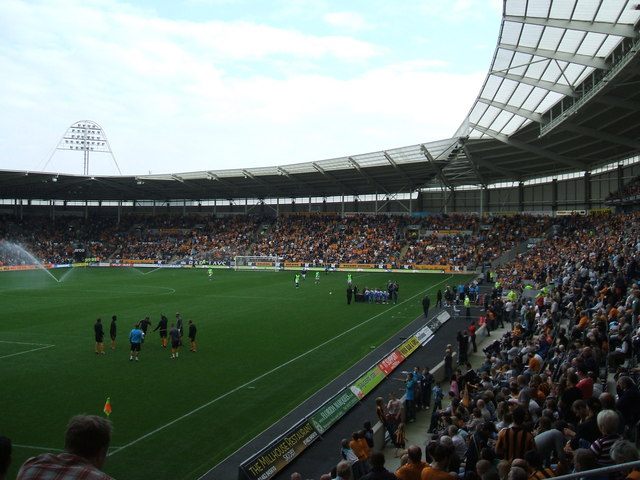
Photo David Brown · CC BY-SA 2.0 · Wikimedia Commons
Hull · EN · England
MKM Stadium
MKM Stadium
Hull's all-seater bowl in West Park, opened in December 2002 and shared by Hull City and Hull F.C. It was the first stadium in England built in a parkland setting.
The facts
Hull City Council · Stadium Management Company (SMC)
The Circle, Walton Street, Anlaby Road, HU3 6HU Hull
The history
The idea of a new stadium for Hull was first raised in 1997. Hull City had played at Boothferry Park since 1946, and funds became available when the city council sold part of its holding in Kingston Communications. The council provided more than £42 million, with the rest coming from regeneration grants and the Football Stadium Improvement Fund.
The council's project team, led by John Topliss, considered more than a dozen sites before choosing The Circle in West Park. Arup Associates prepared the initial concepts, The Miller Partnership adopted them for the design, and Birse Group began construction in the autumn of 2001. The club's receivership in early 2001, just after planning permission was granted, was one of the setbacks.
The complex was completed on time after fourteen months of work, at about £44 million. It opened on 18 December 2002, when 22,467 spectators saw Hull City beat Sunderland 1-0 in a friendly, Steve Melton scoring the first goal. Hull City's first competitive match there was a 2-0 win over Hartlepool United in the second half of the 2002-03 season.
Hull F.C. moved in two months after the football club, ahead of the 2003 Super League season, and played their first match there on 9 February 2003, a Challenge Cup win over Halifax. Hull City and Sunderland contested the Raich Carter Trophy, named after the player who turned out for both clubs, on the opening day in 2002, and they met for it again on 17 December 2022, when the match ended 1-1 in front of 18,120 and Hull retained the trophy.
In 2007 an LED screen replaced the scoreboard in the North Stand. Goal-line technology was installed for the 2013-14 season. Fixed segregation barriers were added to the north-east corner in December 2023, and about 2,700 seats were converted for safe standing for the 2025-26 season.
Great moments
 Hull City1-0
 Sunderland
 England3-2
 NetherlandsEngland2-0Kosovo
Records
Home to
Hull City
Moved in when the stadium opened in December 2002
Hull F.C.
Rugby league, Super League; moved in ahead of the 2003 season
Getting there
The ground stands in West Park, in West Hull, at The Circle off Walton Street and Anlaby Road. Public transport to the ground is not documented here, so matchday travel advice should be checked before travelling.
Tour
Stadium tour
The club's own page should be checked for tour details.
The neighbourhood
The stadium stands within Hull's West Park, and it was chosen partly for its isolation from residential areas and for council ownership of the land. The Circle site was one of more than a dozen considered.
The Hull Fair occupies a neighbouring piece of land. In 2023 the club outlined plans for community pitches and multi-sport facilities around the ground. In September 2024 the fair's organisers called the early plans unacceptable and said they would be willing to boycott if action was not taken to change them.
About
What bora.fans is, in three paragraphs.
bora.fans is a football matchday concierge. You pick the match; the page gathers everything around it — tickets, flights, coaches, accommodation, the stadium, the bars and restaurants nearby, and the club's official shirt.
Matches, tables, line-ups and live scores come from ge. The guides — club by club, stadium by stadium — were written by people, in Portuguese. Each match's weather forecast is measured, not invented: when there's no reading for that day, the page says so.
bora.fans is not affiliated with any club, league, federation or confederation, nor with ge or Grupo Globo. It's an independent site that organises public information and points to whoever sells.
Updated 3 September 2026
Curation
How places and guides are chosen.
Every address on the page was chosen by hand and tied to a stadium, not a city. Distance is measured from the stadium's own coordinates, which is why one bar shows up in one band for the Maracanã and a different one for São Januário — the two are 2.4 km apart.
Nothing here is generated automatically. The guides are text written by people; squads carry the date that list was true, rather than pretending it holds forever.
When we don't know, the page says so. A stadium with no guide shows no guide; a player with no birth year stays without one. We'd rather leave a field empty than a guess that looks like a fact.
Updated 3 September 2026
Advertise
We haven't published a rate card yet — and the reason is simple.
A media kit states price and reach. We don't have audited audience numbers to publish, and publishing estimates would be exactly the kind of claim this site avoids everywhere else in its content.
When there's something verifiable to state, the rate card goes here. Until then, partnership proposals are welcome at the email below.
Updated 3 September 2026
Contact
For corrections, partnerships and removal requests.
If something on this page is wrong — a kick-off time, a stadium, a score, a player's name — write in. A data correction is the request we like getting most.
This is also where to request a photo's removal, resolve a copyright question, or propose a partnership.
Updated 3 September 2026
Privacy
What's stored, where, and what never leaves your browser.
There's no account, login or sign-up on bora.fans. None of our databases store who you are: there's no user to associate anything with.
Two things live in your own browser. The origin city you choose is stored in localStorage, under the key bora.origin, and your chosen language is stored in a cookie called bf_lang. Both exist so the page doesn't ask again on every visit, and you clear both by clearing the site's data.
If you allow location access, your browser reports a point that we use to suggest the nearest origin city. That point is never sent anywhere: the comparison happens inside the page, against a list of cities that already ships with it. The permission is your browser's, and you can revoke it at any time.
The network that serves the site reports the country and continent the request came from, and we use that only to order matches — the nearest competition first. It isn't recorded.
Purchases happen on each partner's own site. bora.fans never sees a card, a national ID number, or a delivery address, because none of that passes through here.
The infrastructure is enterprise-grade edge infrastructure, ready for LGPD, GDPR and CCPA. To exercise any right under those laws, write to the email below — in practice, what we have to delete fits inside your own browser.
Updated 3 September 2026
Terms
The rules of use, no fine print.
Using bora.fans is free. We earn a commission from affiliate partners when you book through here, and you pay exactly the same as you would going direct.
Information is organised carefully and can still be wrong or out of date. Matches get rescheduled, stadiums change, prices vary. Always check the official channel before buying a ticket, a fare or accommodation — the decision and the risk of the purchase are yours.
Scores, tables, line-ups and rounds are published by ge. We're not responsible for that data and have no relationship with whoever publishes it.
Every purchase is a contract between you and the partner who sold it. Cancellation, refunds, delays and billing are resolved with them, under their own terms.
The text, the guides and the pages' organisation are ours. Crests, photos and marks belong to their owners and appear here for reference, with credit where the licence requires it.
Updated 3 September 2026
Cookies
There's one. It's called bf_lang.
bora.fans uses exactly one cookie: bf_lang, which stores the language you chose. It's only written when you deliberately switch language — browsing the site without touching that control writes nothing.
It lasts a year, because language isn't a session preference: whoever wants Spanish today will want Spanish next month too.
There's no analytics, advertising, social-network or third-party cookie. We don't use a Facebook pixel, Google Analytics or anything similar. That's why there's no cookie banner here: there's nothing for you to consent to.
The origin city lives in localStorage, under the key bora.origin. That isn't a cookie and is never sent to the server in any request — it stays in the browser until you clear the site's data.
The stadium's map is a Google Maps iframe and follows Google's own cookie policy. It's the only third-party content the page loads.
Updated 3 September 2026
Affiliates
We earn a commission. You pay the same.
Several links on this page are affiliate links: if you book a flight, a hotel, a coach fare or a shirt through them, we receive a commission from the partner.
That doesn't change your price. The commission comes out of the partner's margin, not your pocket, and the amount is the same as you'd pay typing their address into your browser.
Partners are chosen by who can actually serve that match. A company that doesn't cover the match's city doesn't appear on the card — even if it's in our records — because naming someone who can't serve you is the whole promise and none of the delivery.
No partner pays for a better position, and commission decides the order of nothing on this page.
Updated 3 September 2026
No sign-up
Demo account
Sign in with no email and no password to see how it works. Picks and alerts disappear when you close the tab.
Want to save it for real? Create account