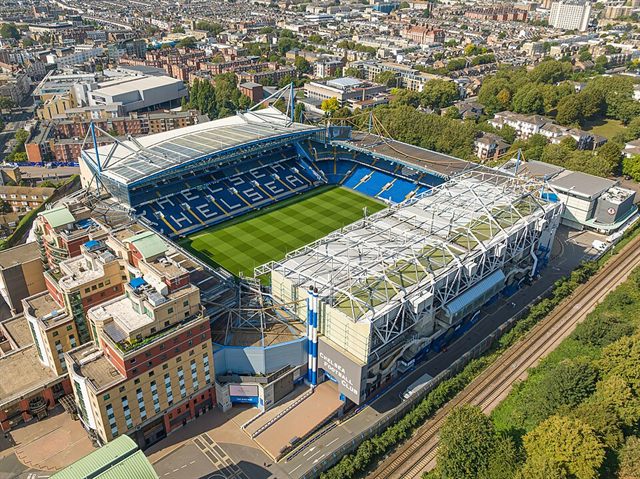
Photo Arne Müseler · CC BY-SA 3.0 de · Wikimedia Commons
London · EN · England
Stamford Bridge
Stamford Bridge · The Bridge
Opened in 1877 as an athletics ground for the London Athletic Club, Stamford Bridge became Chelsea's home when Gus Mears took it over and founded the club in 1905. It was rebuilt as an all-seater stadium in the 1990s.
The facts
Chelsea Pitch Owners · Chelsea
Fulham Road, SW6 1HS London
The history
The name is thought to come from 'Samfordesbrigge', meaning the bridge at the sandy ford, over a stream that ran through the area. The stadium opened in 1877 as a home for the London Athletic Club, with a running track around the pitch. It was planned with a capacity of around 100,000, and was used almost exclusively for athletics until 1904.
In 1904 the lease was acquired by the brothers Gus and Joseph Mears, who wanted to stage professional football there. Gus Mears founded Chelsea Football Club in 1905 to occupy the ground. The ground was converted for football that year, and its only covered stand at the time, the East Stand, had a gabled corrugated iron roof and about 6,000 seats. Stamford Bridge was the venue of the FA Cup final from 1920 to 1922, before Wembley took over in 1923. Its highest official attendance, 82,905, came for a league match against Arsenal on 12 October 1935.
In 1945 Dynamo Moscow, on a tour of the United Kingdom, drew 3-3 with Chelsea at the ground in front of an estimated crowd of more than 100,000, with spectators on the dog track and on top of the stands. The club's fortunes declined in the 1970s and 1980s. The early 1970s redevelopment left only the new East Stand finished, and the freehold was separated from the club and sold. Ken Bates bought the club for £1 in 1982 without the ground, and later reunited the freehold with the club.
The Taylor Report, published after the Hillsborough disaster, required top-division grounds to be all-seater by the 1994–95 season. The stadium was rebuilt through the 1990s, removing the running track and creating four covered, all-seater stands. The Matthew Harding Stand was completed for the 1996–97 season and the Shed End in 1997–98. The East Stand's upper tier is the only part to survive from before the redevelopment.
Great moments
 Chelsea×
 ArsenalChelsea3-3Dynamo Moscow
Records
Home to
Chelsea
Home since 1905
Chelsea Women
Home since 2016
Formerly home to
London Athletic Club
Athletics club, 1877 to 1904
Getting there
Fulham Broadway station, on the District line, is about five minutes' walk away, and has a dedicated match-day entrance. Earl's Court, on the District and Piccadilly lines, is about 27 minutes on foot.
West Brompton, served by London Overground and Southern, is about 20 minutes' walk, and Imperial Wharf about 13 minutes.
Routes 11, 14, 211 and N11 stop at Walham Green, about two minutes' walk away. Routes 28, 295, 306, 424 and N28 stop at Fulham Broadway and Fulham Town Hall, about five minutes' walk away.
Chelsea Harbour Pier, served by London River Services, is about 15 minutes' walk away.
Tour
Stadium tour
The club's own page should be checked for stadium tour details.
The neighbourhood
Stamford Bridge stands on the Fulham Road in Fulham, in the Borough of Hammersmith and Fulham, in West London.
The 1990s redevelopment, designed by KSS Design Group, also created hotels, apartments, bars and restaurants around the stadium, which the club calls Chelsea Village. The Chelsea Megastore occupies the south-west corner of the stadium, and the Shed End contains the club's centenary museum and a memorial wall.
About
What bora.fans is, in three paragraphs.
bora.fans is a football matchday concierge. You pick the match; the page gathers everything around it — tickets, flights, coaches, accommodation, the stadium, the bars and restaurants nearby, and the club's official shirt.
Matches, tables, line-ups and live scores come from ge. The guides — club by club, stadium by stadium — were written by people, in Portuguese. Each match's weather forecast is measured, not invented: when there's no reading for that day, the page says so.
bora.fans is not affiliated with any club, league, federation or confederation, nor with ge or Grupo Globo. It's an independent site that organises public information and points to whoever sells.
Updated 3 September 2026
Curation
How places and guides are chosen.
Every address on the page was chosen by hand and tied to a stadium, not a city. Distance is measured from the stadium's own coordinates, which is why one bar shows up in one band for the Maracanã and a different one for São Januário — the two are 2.4 km apart.
Nothing here is generated automatically. The guides are text written by people; squads carry the date that list was true, rather than pretending it holds forever.
When we don't know, the page says so. A stadium with no guide shows no guide; a player with no birth year stays without one. We'd rather leave a field empty than a guess that looks like a fact.
Updated 3 September 2026
Advertise
We haven't published a rate card yet — and the reason is simple.
A media kit states price and reach. We don't have audited audience numbers to publish, and publishing estimates would be exactly the kind of claim this site avoids everywhere else in its content.
When there's something verifiable to state, the rate card goes here. Until then, partnership proposals are welcome at the email below.
Updated 3 September 2026
Contact
For corrections, partnerships and removal requests.
If something on this page is wrong — a kick-off time, a stadium, a score, a player's name — write in. A data correction is the request we like getting most.
This is also where to request a photo's removal, resolve a copyright question, or propose a partnership.
Updated 3 September 2026
Privacy
What's stored, where, and what never leaves your browser.
There's no account, login or sign-up on bora.fans. None of our databases store who you are: there's no user to associate anything with.
Two things live in your own browser. The origin city you choose is stored in localStorage, under the key bora.origin, and your chosen language is stored in a cookie called bf_lang. Both exist so the page doesn't ask again on every visit, and you clear both by clearing the site's data.
If you allow location access, your browser reports a point that we use to suggest the nearest origin city. That point is never sent anywhere: the comparison happens inside the page, against a list of cities that already ships with it. The permission is your browser's, and you can revoke it at any time.
The network that serves the site reports the country and continent the request came from, and we use that only to order matches — the nearest competition first. It isn't recorded.
Purchases happen on each partner's own site. bora.fans never sees a card, a national ID number, or a delivery address, because none of that passes through here.
The infrastructure is enterprise-grade edge infrastructure, ready for LGPD, GDPR and CCPA. To exercise any right under those laws, write to the email below — in practice, what we have to delete fits inside your own browser.
Updated 3 September 2026
Terms
The rules of use, no fine print.
Using bora.fans is free. We earn a commission from affiliate partners when you book through here, and you pay exactly the same as you would going direct.
Information is organised carefully and can still be wrong or out of date. Matches get rescheduled, stadiums change, prices vary. Always check the official channel before buying a ticket, a fare or accommodation — the decision and the risk of the purchase are yours.
Scores, tables, line-ups and rounds are published by ge. We're not responsible for that data and have no relationship with whoever publishes it.
Every purchase is a contract between you and the partner who sold it. Cancellation, refunds, delays and billing are resolved with them, under their own terms.
The text, the guides and the pages' organisation are ours. Crests, photos and marks belong to their owners and appear here for reference, with credit where the licence requires it.
Updated 3 September 2026
Cookies
There's one. It's called bf_lang.
bora.fans uses exactly one cookie: bf_lang, which stores the language you chose. It's only written when you deliberately switch language — browsing the site without touching that control writes nothing.
It lasts a year, because language isn't a session preference: whoever wants Spanish today will want Spanish next month too.
There's no analytics, advertising, social-network or third-party cookie. We don't use a Facebook pixel, Google Analytics or anything similar. That's why there's no cookie banner here: there's nothing for you to consent to.
The origin city lives in localStorage, under the key bora.origin. That isn't a cookie and is never sent to the server in any request — it stays in the browser until you clear the site's data.
The stadium's map is a Google Maps iframe and follows Google's own cookie policy. It's the only third-party content the page loads.
Updated 3 September 2026
Affiliates
We earn a commission. You pay the same.
Several links on this page are affiliate links: if you book a flight, a hotel, a coach fare or a shirt through them, we receive a commission from the partner.
That doesn't change your price. The commission comes out of the partner's margin, not your pocket, and the amount is the same as you'd pay typing their address into your browser.
Partners are chosen by who can actually serve that match. A company that doesn't cover the match's city doesn't appear on the card — even if it's in our records — because naming someone who can't serve you is the whole promise and none of the delivery.
No partner pays for a better position, and commission decides the order of nothing on this page.
Updated 3 September 2026
No sign-up
Demo account
Sign in with no email and no password to see how it works. Picks and alerts disappear when you close the tab.
Want to save it for real? Create account